


What is a chatbot? How does it help to accelerate your business yield? How can you build your own chatbot?
In today’s time, where customers believe that the experience a company provides is as important as its products or services. That’s where AI chatbots come in. You can pretty much say that bots are a critical part of customer service automation.
What is chatbot?
 Chatbot can be defined as AI based computer program that simulates human conversations. They are also known as digital assistants that understand human capabilities. Bots interpret and process the user requests and give prompt relevant answers.
Bots can through voice as well as text and can be deployed across websites, applications and messaging channels such as Facebook Messenger, Twitter or Whatsapp.
How chatbots work?
Chatbots work by analyzing and identifying the intent of the user’s request to extract relevant entities, which is the most important task of a chatbot. Once the analysis is done appropriate response is delivered to the user. The chatbots work by adopting three classification methods.
Pattern matching
Bots utilize pattern matches to group the text and it produces an appropriate response from the clients. Artificial Intelligence Markup Language (AIML) is a standard structured model of these patterns. A bot is able to get the right answer in the related pattern. The bots react to anything relating it to the correlate patterns.
Natural language understanding (NLU)
NLU is the ability of the chatbot to understand a human. It is the process of converting text into structured data for a machine to understand. NLU follows three specific concepts. They are: entities, context, and expectations.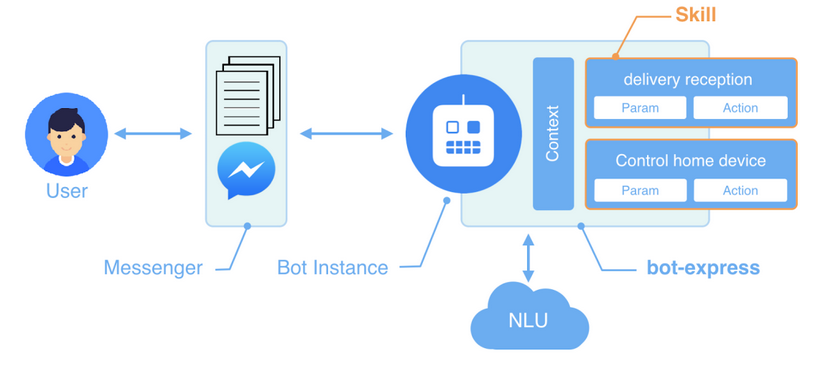
- Entities – It represents an idea to your chatbot. For example, it may be a refund system in your ecommerce chatbot.
- Context – When a natural language understanding algorithm identifies the request and it has no historical backdrop of conversation, it will not be able to recall the request to give the response.
- Expectations – Bot must be able to fulfill the customer expectations when they make a request or ask a query customer says sends an inquiry.
Natural language processing (NLP)
(NLP) Natural Language Processing bots are designed to convert the text or speech inputs of the user into structured data. The data is further used to choose a relevant answer. 
Natural Language Processing (NLP) comprises of the below steps:
- Tokenization – The NLP filters set of words in the form of tokens.
- Sentiment Analysis – The bot interprets the user responses to align with their emotions.
- Normalization – It checks the typo errors that can alter the meaning of the user query.
- Entity Recognition – The bot looks for different categories of information required.
- Dependency Parsing – The chatbot searches for common phrases that what users want to convey.
Types of chatbots
Chatbots process data to deliver quick responses to all kinds of users’ requests with pre-defined rules and AI based chatbots. There are two types of chatbots.
Rule based chatbots
Rule based chatbots follow the predefined paths during conversations. At each step during the conversation, the user will need to pick from explicit options that determine the next step in the conversation.
Key attributes:
- These bots follow predetermined rules. So it becomes easy to use the bot for the simpler scenarios.
- Interactions with rule based chatbots are highly structured and are most applicable to customer support functions.
- Rule based bots are ideally suitable for answering common queries suck as an inquiry about business hours, delivery status or tracking details.
Conversational chatbots
Conversational chatbots are also referred to as virtual assistants or digital assistants. They are much more interactive and personalized than rule based chatbots. The conversational chatbots converse with the users as in a way humans converse and communicate in real-life situations.
Conversational communication skills of the chatbot technology empower them to deliver what customers are looking for.
Key attributes:
- Conversational bots can understand the context and intent of complex conversations and try to provide more relevant answers.
- AI bots apply predictive intelligence and sentiment analysis to understand customer emotions closely.
- Machine learning bots learn from user behavior and provide more personalized conversations.
Why chatbots are important for your business?
Chatbots boost operational efficiency and bring cost savings to businesses while offering convenience and added services for customers. They allow companies to easily resolve many types of customer queries and issues while reducing the need for human interaction.
According to Forbes, 80% of marketers plan to start using a chatbot in some way or another by 2020. This is a significant reason why brands are investing in improving the customer experience.
Let’s find out the importance of adopting the chatbot strategy in your business and how chatbot benefits to win more customers or retain the existing ones.
- Reduce customer waiting time – According to Chatbot Report, 21% of consumers see chatbots as the easiest way to contact a business. Chatbots are a smarter way to ensure that customers receive the immediate response that they are looking for without making them wait in a queue.
- 24×7 availability – 68% of customers switch to a competitor if they don’t think you care about them. Bots are always available to engage customers with immediate answers to the common questions asked by them. The top potential benefit of using chatbots is 24-hour customer service.
- Better customer engagement – Conversational bots can engage customers round the clock by starting proactive conservation and offering personalized recommendations that boost customer experience.
- Easy scalability with bots – Bots can be easily scalable during the peak business hours or and manage ‘n’ number of customer conversations without additional customer service costs.
- Save customer service costs – Juniper Research estimates that chatbots will help businesses save more than $8 billion per year by 2022. Chatbots help businesses to save customer service costs of hiring more support agents that require additional costs such as salary, training and infrastructure costs.
- Automate lead qualification & sales – You can automate your sales funnel with chatbots to prequalify leads and directing them to the right team for further nurturing. Being able to engage customers instantly increases the number of leads and conversion rates.
- Reduce customer churn rate– Engaging your visitors is arguably the single most sure-fire way of reducing bounce rates and subsequently increasing conversions. With chatbots, you can boost your engagement strategy even further and actually keep visitors hooked.
Chatbot use cases
Chatbots act as a catalyst to enhance performance when deployed across different business functions and industries. Here are the key use cases of how customers are getting the most out of conversational chatbots. 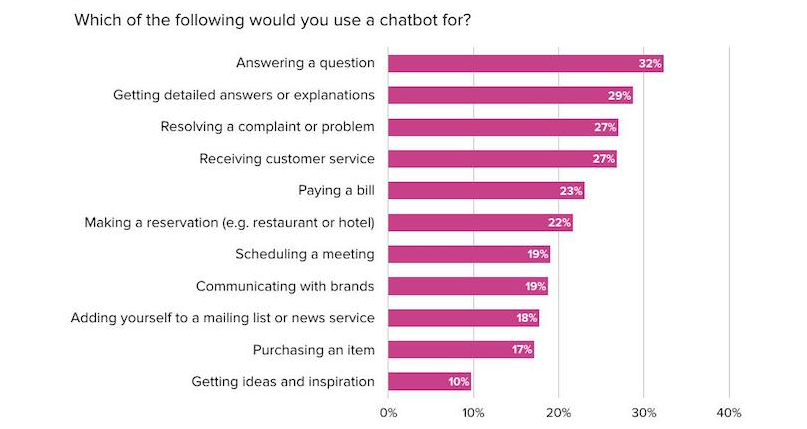
Customer service
Business Insider reports say 67% of consumers worldwide used a chatbot for customer support. Customer service is one of the key business functions where chatbots have a great impact. With AI chatbots, businesses can save customer support costs and improve the key productivity metrics that enhance the customer service experience.
Some key customer service use cases are as follows:
- Website support – Today’s customers expect real time response. Businesses are adopting chatbot technology in order to deliver prompt customer engagement.
- IT helpdesk – Chatbots can help your IT helpdesk to boost your team productivity and drive efficiency.
- In-app support – Having a bot to handle FAQs within applications enhances user engagement. It enables businesses to send notifications to keep customers updated.
Sales
Lead generation is the most important function of every business. With chatbots, you can pre-qualify your leads and automate your sales funnel. You can do so by sending the leads right into your CRM or transfer to the sales reps to assist them further.
The key use cases of sales bots are:
- Segment your audience – Bots enables you to identify the product interests of visitors and customers. Based on that you can segment your target audience.
- Pre Qualifying leads – Bots, programmed with a predefined sales questionnaire converts your website visitors into prospects. Then they are directed to the next level of the sales funnel.
- Bookings – Bots help for scheduling appointments for hospitality or health care, and also make bookings for personal services.
Marketing
Bots can learn from user interaction and share relevant information regarding your brand, products, and services. Essentially, it’s able to up-sell and cross-sell in a personalized, conversational, and engaging way. 57% of businesses agree chatbots deliver a large return on investment (RoI) with minimal effort.
The bot marketing use cases for better customer engagement are:
- Product recommendations – With bots, you can recommend products or combo offers based on the customer journey.
- Start a proactive conversation – Bot can initiate proactive conversation while the customer is stuck within the product and guide towards the right direction.
- Personalized notifications – You can learn your customer behavior and improve your conversations by personalizing it.
Final thoughts: What is a chatbot and why it matters?

Now, as you are aware of what is a chatbot and how important it is for your business, you will certainly agree that chatbots have drastically changed the way businesses interact with their customers.
AI bots have become a vital part of a customer engagement strategy. Near to future bots will advance to enhance human capabilities and human agents to be more innovative, in handling strategic activities.
In order to build a chatbot effective, you can follow the below guidelines
- Identify your business requirements and build the bot across your key use case. Your bot should match your business requirements and boost customer satisfaction. You can measure the metric to understand the bot ROI.
- Use the right platform that covers the bot and live chat as a complete toolkit, so that your team can understand the customer journey better and have better control over the customer conversations.
Source: https://www.revechat.com/blog/what-is-a-chatbot/